
Stop using the door
Cable snapped in Miami, FL
You have a cable hanging loose and the door is sitting crooked. One side has dropped, the other side is still up, and there is a frayed steel cable dangling somewhere near the bottom corner. That is a broken lift cable. The cable carries the weight of the door, so when it lets go, the door tilts and the load shifts onto the other side.
Phones answered around the clock · free estimate
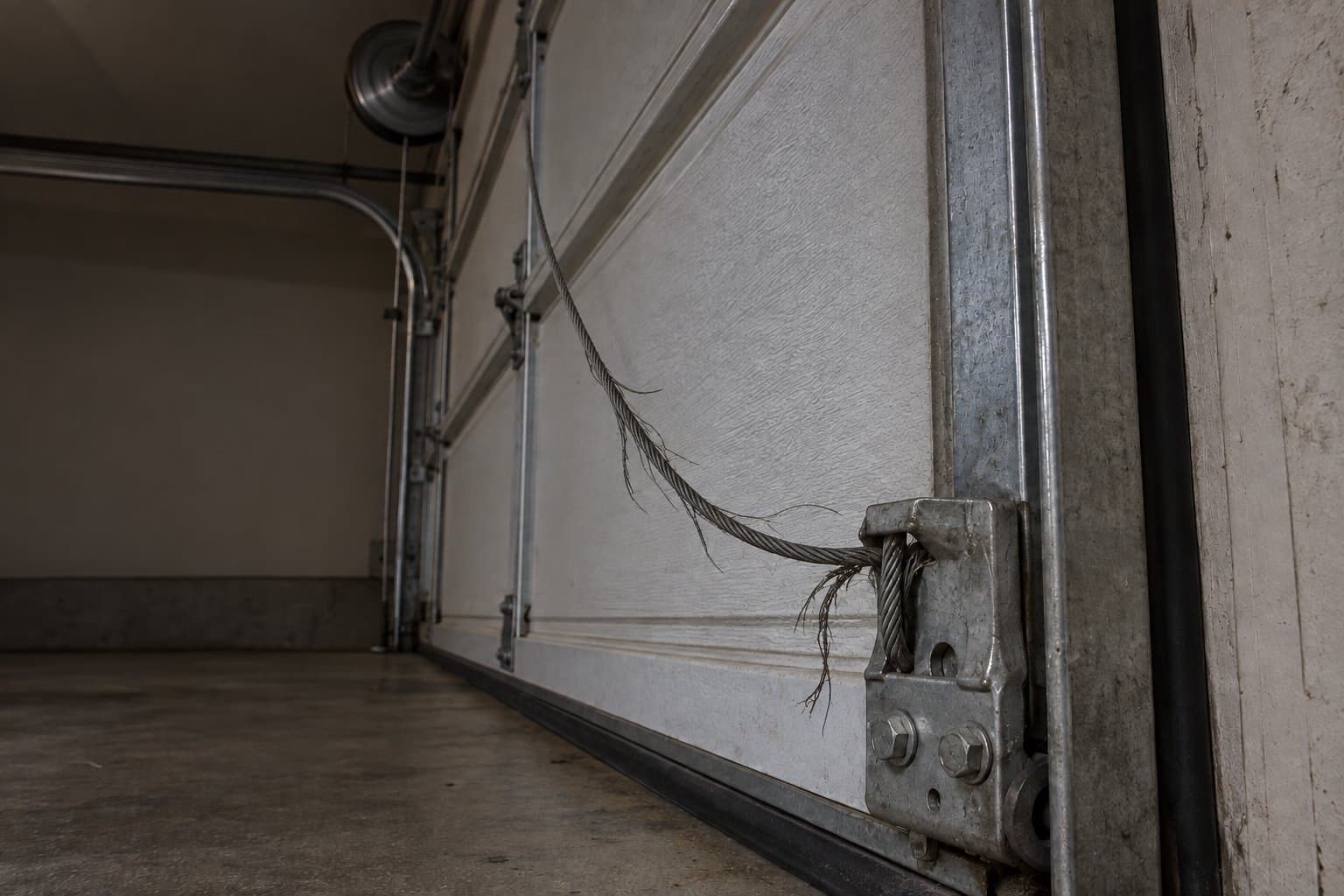
In Miami the cause is very often rust, not age or hard use. Salt-laden air off Biscayne Bay and the Atlantic, plus high humidity nearly year-round, eats at cables, drums, springs, hinges and fasteners much faster than it does inland. Rust at the drum where the cable winds is a common failure point. Near the water, stainless and coated hardware is close to mandatory for that reason. Many older Miami homes are concrete block and stucco with a single one-car garage door, so one cable failing takes out your only way in and out.
While you wait — please don't
- Stop using the door. A crooked door under tension is the most dangerous state a garage door gets into, and running the opener can drag it further out of square or off its track.
- Do not pull on the hanging cable. That cable is still connected to loaded hardware, and pulling it can release tension with no warning.
- Do not try to replace it yourself. Cables, springs and drums hold enough stored energy to cause serious injury, and this is not a job to take on with hand tools in your driveway.
- Do not prop the door and leave it. A tilted door held up by a ladder or a broom can slip sideways, so keep people, pets and cars out from under it until a technician has it secured.
What the technician does
- The door is secured firstBefore anything else the technician takes the load off the door so it is safe to work on. Nothing gets unwound while the door is hanging crooked.
- Cables are replaced in pairsEven if only one broke, both are replaced, and they are sized to your door height. Matching cables is what keeps both sides lifting the same.
- Drums are re-seated and re-setThe drums are reset so both cables wind evenly. If corrosion at the drum is what cut the cable, the technician will show you what they found.
- Springs are checked at the same timeSprings and cables live in the same salt air and rust on the same schedule. Checking them while the door is already open avoids a second failure days later.
- The door is re-squaredOnce the new cables are on, the door is brought back level in its tracks so it is not riding against one side.
- Cycle tested before they leaveThe door is run up and down to confirm it tracks straight, stays balanced and stops where it should.
Why this happens in Miami, FL
Corrosion is the number one killer of garage door springs, rollers, cables and exterior hardware in Miami, and it is worst within a mile or two of Biscayne Bay. It is not cold and it is not wear. Freeze, hail and snow risk here is negligible. What you get instead is constant humidity and salt, working on steel parts every day of the year. Homes in Brickell, Edgewater, Coconut Grove and along Coral Way all sit in that exposure, and the same goes for the surrounding cities like Miami Beach, Key Biscayne and Aventura.
Timing matters too. Demand across Miami climbs from roughly May through November for hurricane season work, and again in the winter snowbird months when seasonal residents open up homes and condos that have been shut for months. A door that sat unused through a humid summer often shows its rust the first time someone runs it. If you live in a condo community or a gated neighborhood, exterior work often needs HOA approval, so it helps to know your association's rules before anything is scheduled. And if the conversation moves from cables to a full replacement door, note that Miami-Dade is in the High-Velocity Hurricane Zone, where replacement doors must be product-approved and impact-rated. Confirm the exact rating required for your address with your local building department.
Questions people ask
- Can I use the door until someone comes out?
- No. The door is crooked and under tension, which is the most dangerous condition a garage door gets into. Leave it alone, keep everyone clear of it, and if your car is shut inside, tell us that when you call.
- Why do cables break so often in Miami?
- Salt air off Biscayne Bay and the Atlantic, combined with year-round humidity, corrodes cables, drums and fasteners far faster than inland conditions. Rust at the drum is a common cause. Coated and stainless hardware holds up better near the water.
- Why replace both cables when only one broke?
- Both cables sat in the same salt air for the same number of years, so the second one is rarely far behind. Cables are replaced in pairs and sized to the door height so both sides wind and lift evenly.
- Do I need a permit for this?
- In Florida a permit is typically required to replace a garage door, because the door is part of the building envelope. Cable and hardware repair is different work, and permitting is handled locally, so check with your city or county building department if you are unsure.
- What does One Call Garage Door actually do?
- We are a referral and scheduling service that arranges garage door service with independent local technicians across all fifty states. We are not the contractor and we do not perform the work. Licensing is the technician's own and varies by jurisdiction, so confirm it with them and with the Florida DBPR or your local licensing board.
One call
Make one call to (866) 394-4210 and we will arrange for an independent local technician to look at your door in Miami. The estimate is free, and the technician gives you the price before any work starts so you approve it first.
Something else in this area
- Door is off its track
- Opener or remote dead
- Stuck half open
- Loud, grinding or shaking
- I want a new door
- Loud bang, door won't lift
- Door won't open or close
One Call Garage Door arranges the visit; the technician does the work and gives you the price.