
Stop using the door
Broken garage door spring in St. Petersburg, FL
If you heard a bang from the garage and now the door will not lift, a spring has almost certainly broken. Look at the shaft above the door opening. A torsion spring that has snapped will show a clear gap, with the coil separated into two pieces. On doors with springs running along the side tracks, one may be stretched out, hanging loose or in two parts. The door itself may feel like it weighs a ton, or it may lift a foot and slam back down. The opener might hum and strain and get nowhere.
Phones answered around the clock · free estimate
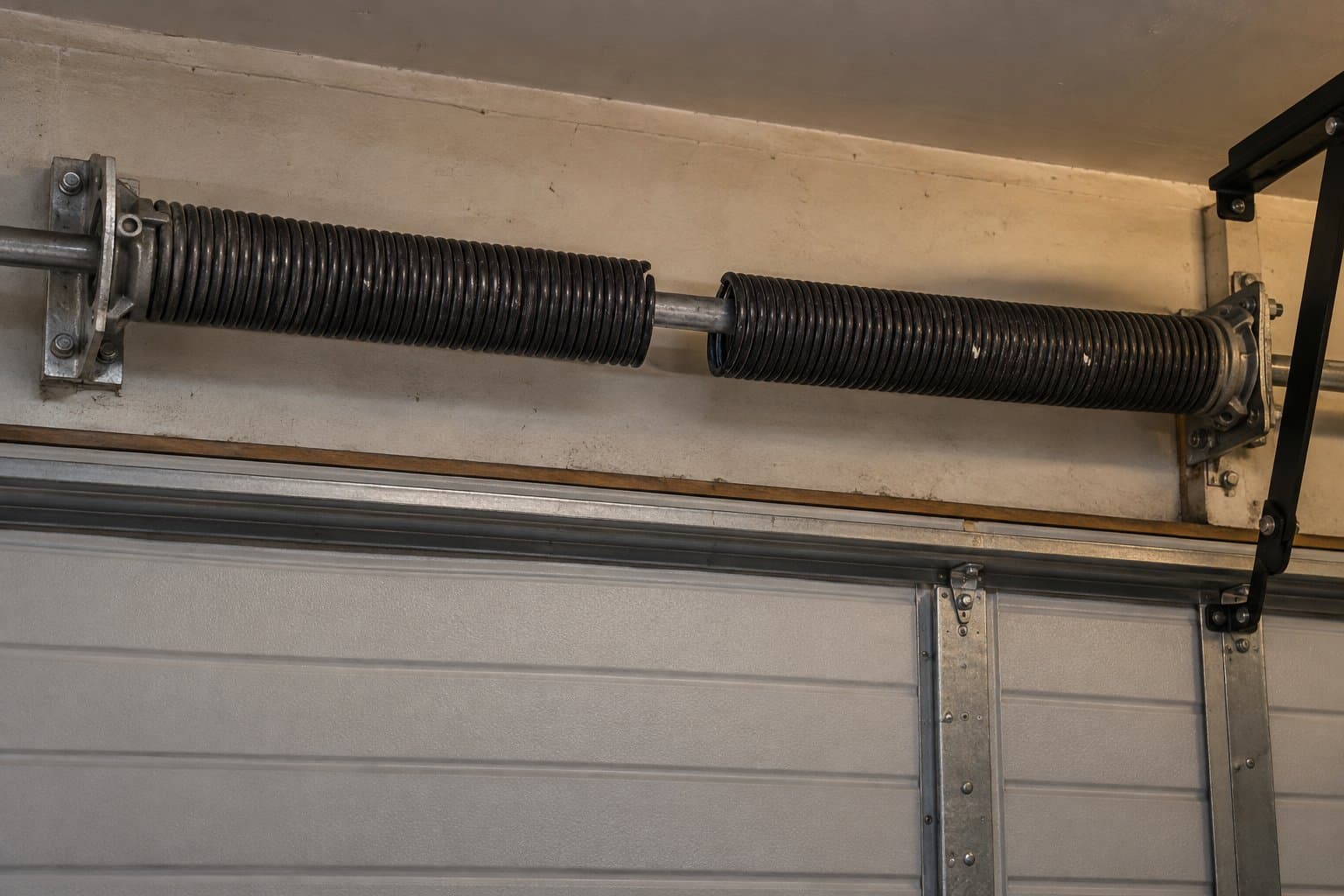
The springs are what carry the weight of the door. The opener only guides it. When a spring goes, that weight lands on you, on the opener, and on the cables. In St. Petersburg this happens for two reasons. First, cycle life, not age, decides when a spring is done — a household that runs the door a dozen times a day wears springs out faster than a neighbor who barely uses theirs. Second, corrosion. St. Petersburg sits on a peninsula between Tampa Bay and the Gulf, and salt-laden air reaches nearly every property, eating at springs, rollers, hinges and tracks. Florida's constant heat and humidity speed the rust along. Hard freezes are rare here, so the cold snaps that finish off tired springs up north are not the trigger — here it is use and it is salt.
While you wait — please don't
- Stop using the door. A door with a broken spring is unbalanced and can drop without warning, so leave it down and park outside until it is fixed.
- Do not touch the torsion springs. Torsion springs sit under extreme tension and need special bars and technique to unwind safely — a slip can break bones.
- Do not force the door up by hand. The door now weighs whatever the springs were carrying, and people hurt their backs and crush their fingers trying to muscle it open.
- Do not keep pressing the opener. The opener was never built to lift the full weight of the door, and repeated attempts can strip the gears or burn out the motor.
- Get the car out only if it is safe. If your car is shut in and the door will not move on its own, wait for the technician rather than propping the door up on anything.
What the technician does
- The door gets weighed and measuredSprings are sized to the door's weight, height and drum type, not guessed at. The technician checks what your door actually needs before choosing parts.
- Springs are replaced in pairsIf one spring broke, the other has run the same number of cycles and is close behind. Replacing both together keeps the door balanced and saves a second call later.
- Cables, drums and bearings get checkedA snapping spring often frays a cable or knocks a drum out of position. Bearings that are dry or rusted get caught at the same time.
- The door is rebalancedOnce the new springs are wound, the door should hold its position halfway up without drifting. That balance is what protects the opener.
- The opener safety reverse is testedForce settings and the reversing function are checked so the door stops and backs off when something is in its path.
- You approve the price firstThe estimate is free. The technician looks at the door, gives you the price, and nothing gets done until you say yes.
Why this happens in St. Petersburg, FL
Salt air is the defining garage door problem in St. Petersburg. Homes a few miles from Tampa Bay or the Gulf get rust on springs, rollers, hinges and tracks far faster than inland Florida. That matters with springs, because a corroded coil fails earlier than a clean one at the same cycle count. Neighborhoods close to the water — Snell Isle, Coquina Key, Shore Acres, Old Southeast — live with this every year. In low-lying waterfront areas like Shore Acres, repeated flooding also ruins bottom door sections and openers, so a spring call there sometimes turns up water damage further down the door.
The housing stock shapes the job too. A very large share of St. Petersburg homes are 1950s–1970s concrete block and stucco ranches, often with a single-car attached garage or a detached alley-access garage, while the historic districts hold 1920s bungalows. Older single doors and older hardware are common, and so are doors that have been cycling for decades. Demand across St. Petersburg spikes around hurricane season, June through November, and again in the November-to-April snowbird stretch when seasonal residents come back and open up homes that sat shut for months. Keep in mind that if you end up replacing the door rather than the springs, Florida Building Code wind-borne debris rules mean a replacement door generally needs a wind-load rating, a permit is typically required, and the exact rating for your address should be confirmed with the local building department.
Questions people ask
- Can I just replace the one spring that broke?
- It is not the way it is normally done. The second spring has the same cycles on it and is likely to go soon after, and a mismatched pair leaves the door out of balance. Springs are replaced in pairs and sized to the weight of your door.
- Why did my spring break if the door is not that old?
- Cycle life decides when a spring goes, not the calendar. A St. Petersburg household that opens the door many times a day gets through springs faster than one that uses it twice. Salt air and Florida humidity corroding the coil shortens that life further.
- Does living near the water in St. Petersburg make this worse?
- Yes. Salt-laden air reaches nearly every property on the peninsula, and homes within a few miles of Tampa Bay or the Gulf see rust on springs, rollers, hinges and tracks much sooner than inland Florida homes. It is the single biggest maintenance issue for garage door hardware here.
- Can I open the door manually until someone comes?
- Please do not. With a broken spring the door carries its full weight, and people injure themselves forcing it. Leave it closed and keep kids and pets away from it.
- Are you the company doing the repair?
- No. One Call Garage Door is a referral and scheduling service that arranges garage door service with independent local technicians across all fifty states, including St. Petersburg. We are not the contractor and we do not perform the work — licensing is the technician's own and requirements vary by jurisdiction.
One call
Call (866) 394-4210 and we will arrange a local technician to look at your St. Petersburg door. The estimate is free, and you approve the price before any work starts.
Something else in this area
- Opener or remote dead
- Dented or damaged panel
- Stuck half open
- I want a new door
- Door won't open or close
- Cable snapped or loose
- Loud, grinding or shaking
- Door is off its track
One Call Garage Door arranges the visit; the technician does the work and gives you the price.