
Why does my garage door opener hum but the door will not move?
A hum with no movement means the opener is getting power and trying to run, but something is stopping it — most often a broken spring that has left the door far too heavy to lift, a stripped drive gear or sprocket inside the opener head, or a motor capacitor that no longer has the punch to turn the motor. Less often the trolley has come off the rail, the manual slide lock on the door is thrown, or the door itself is jammed in its track.
Phones answered around the clock · free estimate
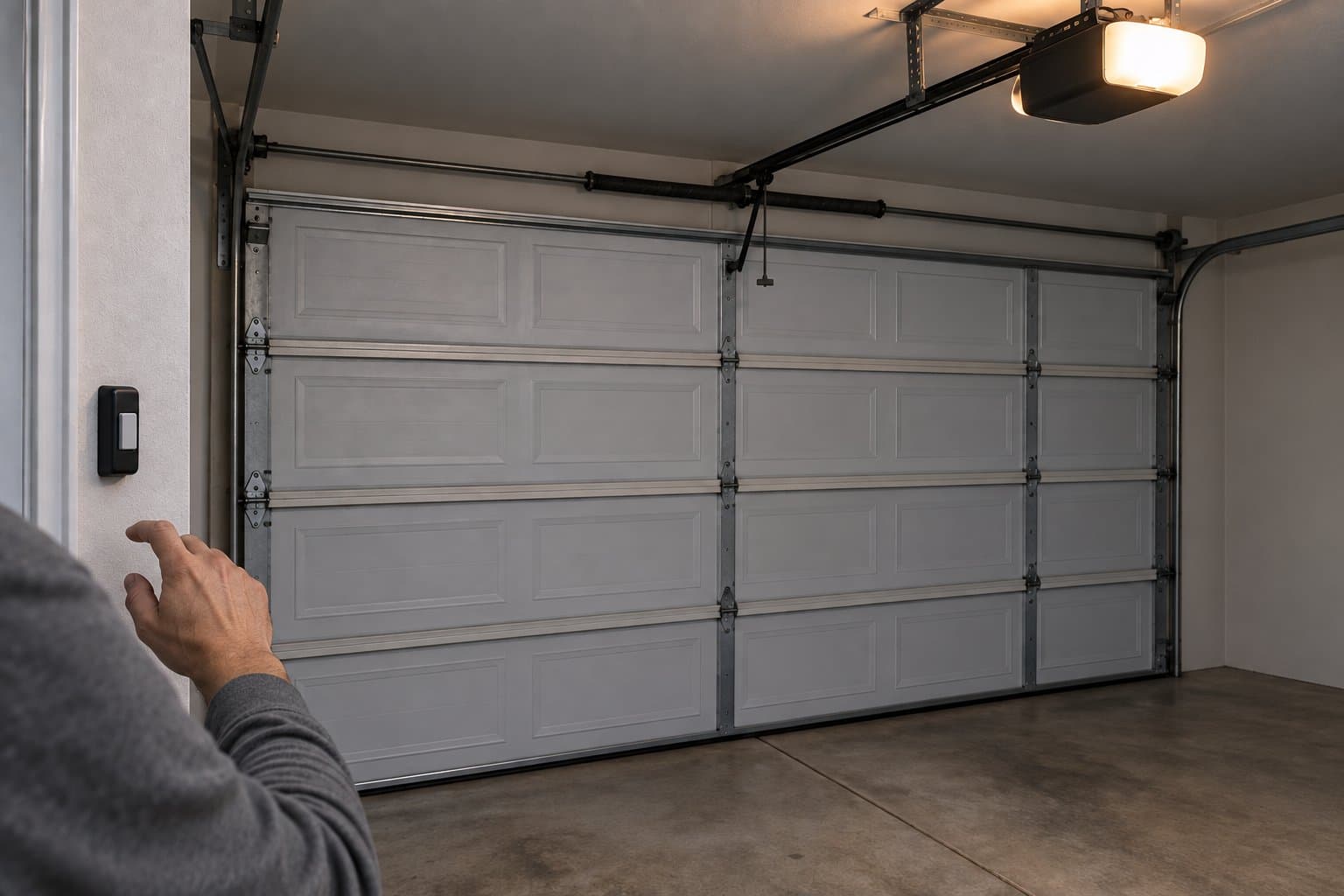
The quickest way to tell the two families apart: if the opener hums and nothing at all turns — no chain, no belt, no screw shaft — the fault is usually inside the opener. If the chain or belt moves but the door stays put, the opener is fine and the problem is the door, the springs or the connection between them.
Why it happens
A garage door opener is a small motor. It does not lift the door — the springs above the door carry nearly all of the weight, and the opener only nudges a balanced door along. When a spring breaks, that balance is gone, the door becomes dead weight, and the motor strains against it and hums until the thermal cutout stops it.
Inside the opener head, the motor turns a plastic gear that drives the chain, belt or screw. That gear wears out. When the teeth strip, the motor spins or hums freely while nothing moves, and you often find fine plastic shavings on the floor under the unit.
The third common cause is electrical. Openers use a capacitor to start the motor. When it weakens, the motor gets voltage but cannot get moving, so it sits there humming. Power cuts and surges are hard on opener boards and capacitors, and they can un-pair remotes at the same time, which is why a hum sometimes arrives alongside other odd behaviour.
What you can check yourself
- Look at the spring for a gapStand clear and look at the spring above the door or along the sides. A finger-width gap in a coil, or a spring in two pieces, means a broken spring — stop using the door and do not try to lift it.
- Look for a loose or hanging cableA cable drooping off its drum or coiled on the floor means the door is no longer under control. Leave it alone and keep people and cars away from the opening.
- Check the manual lockMany doors have a slide bolt or a handle that throws a bar into the track. If it is engaged, the opener will hum against a door that is physically bolted shut.
- Watch what moves when it humsFrom a safe distance, see whether the chain, belt or screw shaft moves at all. Nothing moving points at the opener; the drive moving while the door stays points at the door and its springs.
- Look under the opener headPlastic shavings or black grease flakes on the floor below the motor unit are the usual sign of a stripped drive gear.
When to call a technician
Call once you see a gap in a spring, a loose cable, a door sitting crooked in its tracks, or an opener that hums and does nothing. Springs and cables are under high tension and are not a homeowner repair — and running a crooked door again, or holding the wall button down to force it, makes the damage worse. Leave the car where it is and leave the door where it is.
One Call Garage Door arranges the visit with an independent local garage door technician at (866) 394-4210. The estimate is free, the technician looks at the door and gives you the price before any work starts, and you approve it first. Repairs like springs, cables, rollers or an opener almost never need a building permit; licensing rules vary by state and many states leave it to the city or county. The technician holds whatever license their state requires, and your state's contractor licensing board is the place to verify it.
What the technician will do
- Separate opener from doorThey release the door from the trolley and test both independently, so the fault is traced to the spring system, the opener drive or the door itself before anything is quoted.
- Diagnose the opener driveGear and sprocket wear, trolley damage, and motor or capacitor failure all read differently. The technician identifies which one, and whether the unit is worth repairing.
- Inspect springs, cables and tracksBroken or fatigued springs, frayed cables and bent track are checked together, because one failing part usually loads the others.
- Rebalance the doorOnce the failed part is replaced, the door is balanced so it holds position on its own and the opener is doing only the work it was built for.
- Test the safety reverse and sensorsThe photo-eye sensors are realigned and the reversing force is tested before the job is called done.
Related questions
- Is it safe to pull the red release cord and lift the door by hand?
- Only if the springs are intact. If a spring is broken, the door is dead weight and can drop once released, so leave the cord alone and leave the door closed until a technician has looked at it.
- Can a humming opener be fixed, or does it need replacing?
- It depends on what inside has failed and whether parts for that model are still made. A stripped gear or a worn trolley is often a repair; an older unit with a failed board or motor is frequently better replaced. The technician tells you which before any work starts.
- Why did this happen right after a power cut?
- Surges are hard on opener circuit boards and capacitors, and they can wipe the remote pairing at the same time. A motor that hums without turning after an outage often points at the capacitor or the board rather than the door.
- What does it cost to fix?
- It depends on the size and weight of the door, which part failed, whether parts for that opener are still available, and what the technician finds once the cover is off. The estimate is free and the price is confirmed with you before any work begins.
Get a technician out
Free estimate. The price is agreed before the work starts.
Or send us a message
Leave your details and what the door is doing, and someone from the team will call you back.
One Call Garage Door arranges the visit; the technician does the work and gives you the price.