
Why does my garage door stop halfway and refuse to move up or down?
A door that stops halfway and will not budge in either direction has almost always lost its balance — a broken or weakened spring, a slipped or frayed cable, or a roller that has jumped and is now binding in the track. The opener is not strong enough to lift the dead weight, and its safety force setting stops it rather than tearing the door apart.
Phones answered around the clock · free estimate
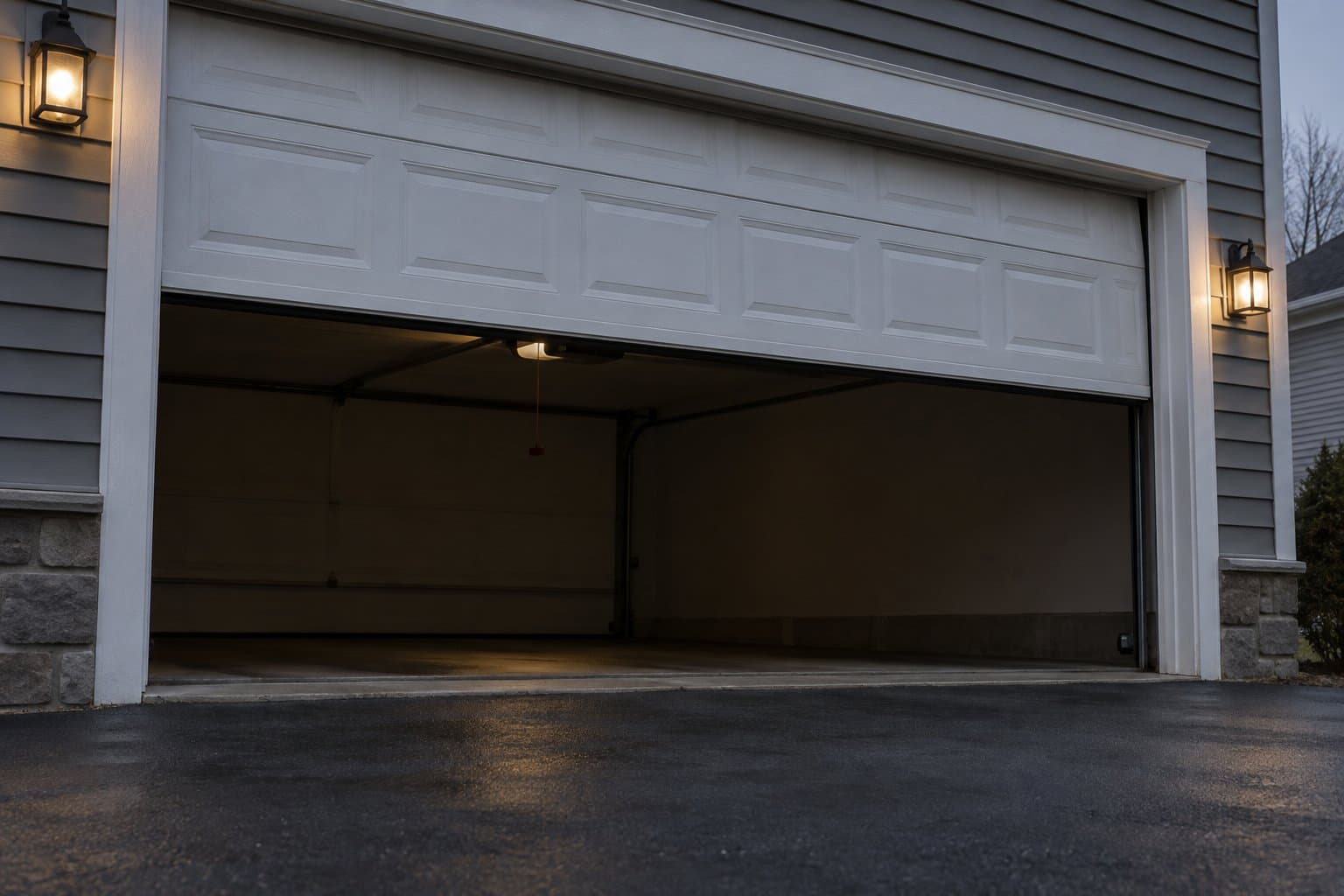
The exception is a door that is physically caught on something: a bent track section, a loose hinge, a locked side latch, or an object in the opening. In that case the door is not unbalanced, it is jammed, and forcing the opener again only bends more track.
Why it happens
Garage doors are counterbalanced. Springs do the lifting; the opener only guides the door and holds it in position. When a spring breaks or a cable comes off its drum, the balance disappears, and the full weight of the door lands on the opener mid-travel. The opener stalls, reverses a little, or simply stops with the door half up.
A door that is off track behaves the same way from the driveway. A roller leaves the track, the door twists in the opening, and the binding stops it in place. You may see a gap between the door edge and the vertical track, or one side sitting lower than the other.
Openers also have travel limits and force settings. If those drift, or if the motor gear is worn, the opener can quit partway even when the door itself is fine. That is why a technician checks springs, cables, rollers, track and opener as one system instead of adjusting the opener first and hoping.
What you can check yourself
- Look at the springs from a safe distanceStand back and look at the spring above the door or along the side rails. A visible gap, a spring in two pieces or a curled end means the door has lost its counterbalance — do not touch it and do not try the opener again.
- Look for a loose or hanging cableA cable dangling down beside the door, slack in the cable, or one that has unwound off the drum tells you the problem is structural. Leave it alone; those cables are under high tension.
- Check the side lockMany doors have a manual slide lock or a T-handle latch. If someone threw it, the door can travel a few inches and stop hard against the bar.
- Look down the track edgeSight along the vertical track on both sides. A roller out of the channel, a bowed section, or a visible gap between the door and the track means the door is off track and should not be moved.
- Stop cycling itRepeated attempts to open or close a stuck door bend the track and can pull more rollers out. One try is diagnosis; five tries is damage.
When to call a technician
If you see a broken spring, a loose cable, or a door sitting crooked in its opening, the repair is past DIY. Those parts hold the stored energy that lifts a door that can weigh a few hundred pounds, and they are not safe to release or re-tension without the right tools. Nobody should stand or reach under a partly-raised door, and the garage should not be left open overnight — it is a security problem, and in bad weather a water problem too.
A spring, cable, roller or opener repair almost never needs a building permit; a full door replacement does in some cities, and in most coastal high-wind and hurricane zones where the new door has to carry a wind rating. Your local building department decides. Licensing rules vary by state too — the technician holds whatever license their state requires, and your state's contractor licensing board is where you verify it. One Call Garage Door arranges the visit with an independent local garage door technician, the estimate is free, and the technician gives you the price before any work starts. Call (866) 394-4210.
What the technician will do
- Secure the door firstBefore anything else the door is clamped or blocked so it cannot drop or shift while it is being worked on.
- Check the system, not just the symptomSprings, cables, drums, rollers, hinges and track are inspected together, because a failure in one usually marks another.
- Restore the balanceOnce the failed part is replaced, the door should hold its own position roughly halfway with the opener disconnected. That test is the proof the repair is correct.
- Reset the openerTravel limits and force settings are reset so the opener stops where it should and reverses on contact.
- Price before workThe technician looks at the door and gives you the price first. You approve it before anything is replaced.
Related questions
- Can I pull the release cord and move the door by hand?
- Only if the springs and cables are intact. If a spring is broken, the door becomes full dead weight and can slam down once released, so leave the cord alone and keep everyone clear until a technician looks at it.
- Can I close the garage to secure it until the repair?
- Not by force. If the door is stuck because of a broken spring or an off-track roller, pushing it down bends track and can drop the door. A technician can secure or close the door safely as part of the visit.
- Could it just be the opener and not the door?
- It can be. A worn gear, drifted travel limits or a failing capacitor will stall a door mid-travel even when springs and cables are fine. A quick balance test tells the two apart, which is why both get checked.
- If one spring broke, does the other need replacing too?
- On a two-spring door, both springs have taken the same number of cycles, so when one goes the other is usually close behind. Technicians commonly recommend replacing the pair so the door stays balanced.
Get a technician out
Free estimate. The price is agreed before the work starts.
Keep reading
Or send us a message
Leave your details and what the door is doing, and someone from the team will call you back.
One Call Garage Door arranges the visit; the technician does the work and gives you the price.