
Why is my garage door crooked with one side higher than the other?
A garage door that hangs crooked, with one side higher than the other, almost always means a lift cable on the low side has snapped, frayed through, or unwound off its drum. The side that still has a working cable keeps lifting, the other side drops, and the door racks out of square in the opening.
Phones answered around the clock · free estimate
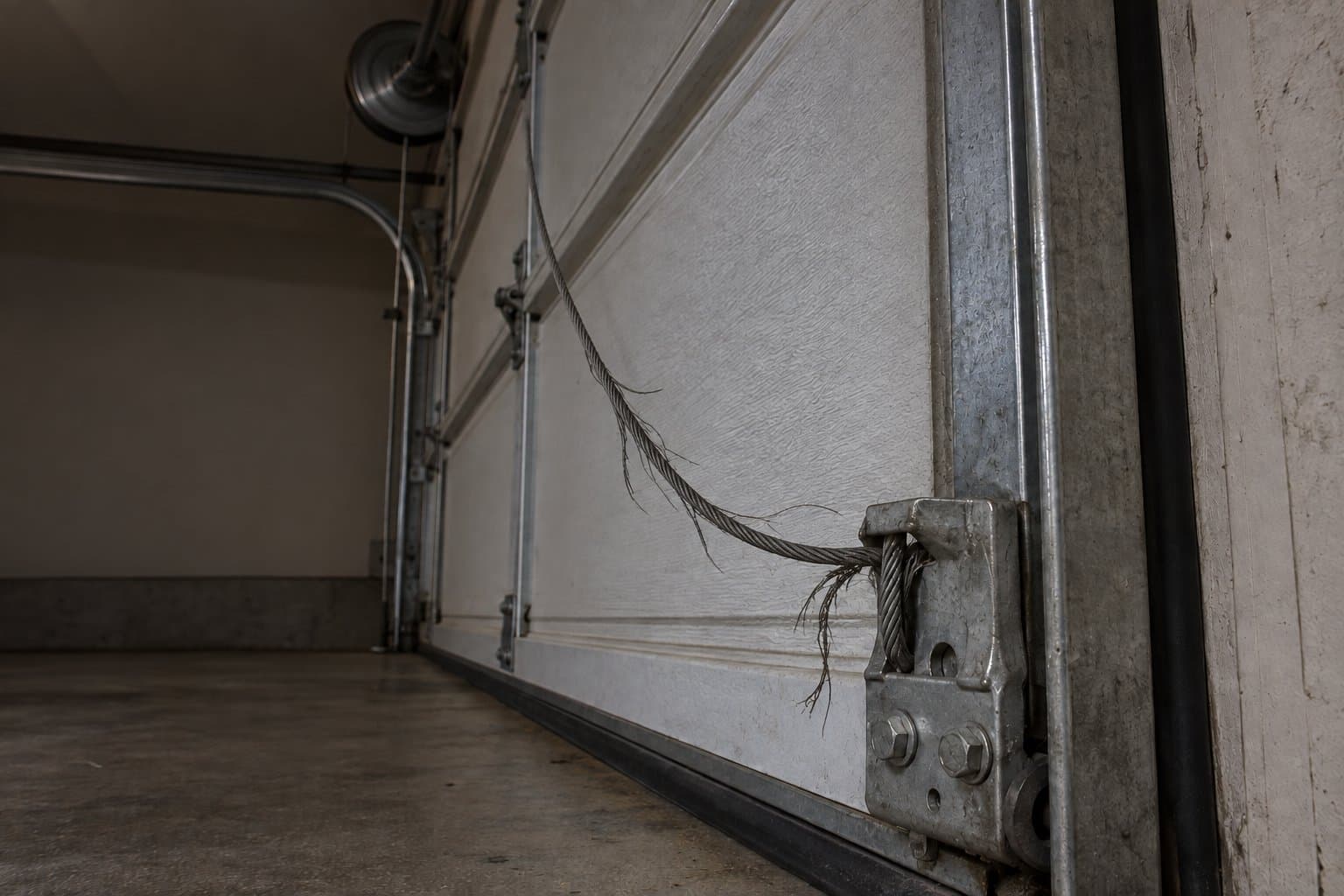
Stop using the door and leave it where it is. A crooked door is the most dangerous state a garage door gets into — the weight is no longer shared evenly and the remaining spring and cable are carrying all of it. Do not run the opener, do not pull on a hanging cable, and keep people and cars out from under the door until a garage door technician has looked at it.
Why it happens
Your door is lifted by two steel cables, one on each side, that run from the bottom bracket up to a drum at the end of the spring shaft. The springs do the lifting; the cables just transfer that force to the door. Both cables have to wind onto their drums at exactly the same rate or the door tilts.
Cables fail a few ways. They fray strand by strand where they bend around the drum or the bottom bracket, then part under load. They slip off the drum if the door gets jammed, if it lands on something, or if the drum set screws work loose. And they rust — corrosion at the drum is a common cause anywhere humidity or road salt reaches the hardware, and a rusted cable loses strength long before it looks obviously bad.
Sometimes the cable is fine and the real fault is upstream: a broken spring, a shaft that has shifted, or a drum that has slipped on the shaft. The symptom looks identical from the driveway. That is why cables are replaced in pairs and the springs and drums are checked at the same time — fixing one cable on a door with a worn mate or a tired spring just moves the failure.
What you can check yourself
- Look along both sides, from a distanceStand back and look for a cable hanging slack, coiled on the floor, or wrapped loose around the shaft. That confirms the cable rather than something else.
- Look at the springs without touching themA spring with a visible gap in the coil, or two pieces where there was one, has broken. Note it and tell the technician — it changes what the repair involves.
- Check whether the door is still on its tracksIf a roller has pulled out of the track on the low side, the door is off track as well as cable-damaged. Do not try to push it back in.
- Unplug the openerPull the plug or switch off the breaker so nobody presses a remote by habit. Running the opener on a crooked door can pull it further out of the opening.
- Do not use the release cord to force itPulling the manual release on an unbalanced door lets the full weight go to one side. Leave the door where it sits.
When to call a technician
A crooked door is past DIY in every case. The cables, springs and drums are all under tension even when the door is down, and the tools and the winding procedure are specific to the trade. If a car is shut inside, say so when you call — the technician can plan for that rather than you trying to free it yourself.
Whether garage door repair needs a state contractor license varies by state, and many states leave it to the city or county. The technician holds whatever license their state requires, and your state's contractor licensing board is the place to verify it. A cable or spring repair almost never needs a building permit; a full door replacement does in some cities, and in most coastal high-wind and hurricane zones where the new door has to carry a wind rating, so ask your local building department before ordering a door.
What the technician will do
- Secure the door firstThe door is clamped or supported so the load is controlled before anything is unwound.
- Replace both cables as a pairCables are sized to the height of your door and replaced on both sides, so the two match in length and condition.
- Re-seat and re-set the drumsThe drums are set on the shaft so both cables wind evenly and the door lifts level.
- Check the springs at the same timeSprings, bearings and the bottom brackets get inspected while the door is apart, since a worn spring will take the new cables out too.
- Re-square and cycle testThe door is brought back square in the opening, balanced, and run through full cycles to confirm it tracks straight and stops where it should.
Related questions
- Can I just replace the one cable that broke?
- It is not worth it. The second cable has the same age, the same wear and the same exposure, and it is carrying the load alone right now. Cables are replaced in pairs so both sides wind at the same rate.
- Can I lift the door by hand to get my car out?
- No. With one cable gone the weight is unbalanced and the door can rack or drop on the low side. Wait for a technician and mention the car when you call.
- What does cable repair cost?
- It depends on the height and weight of the door, whether one or both cables failed, whether the springs or drums also need replacing, what the technician finds once the door is secured, and how easy the hardware is to reach. The estimate is free — the technician looks at the door and gives the price before any work starts, and you approve it first.
- How do I keep cables from failing again?
- Have the hardware looked at periodically and replace cables showing rust or broken strands before they part. Keeping the door balanced matters most, since a tired spring makes the cables do work they were never meant to do.
- How do I arrange a visit?
- Call One Call Garage Door at (866) 394-4210 and we will arrange the visit with an independent local garage door technician. We schedule the work; the technician does it and quotes it.
Get a technician out
Free estimate. The price is agreed before the work starts.
Keep reading
Or send us a message
Leave your details and what the door is doing, and someone from the team will call you back.
One Call Garage Door arranges the visit; the technician does the work and gives you the price.