
Why does one section of my garage door look bowed in the middle?
A section bows in the middle when the panel has been pushed past its limit or has lost its stiffness. The usual causes are a vehicle bump, hail or storm debris, a crease that weakened the steel, or a missing or failed reinforcing strut on a wide door.
Phones answered around the clock · free estimate
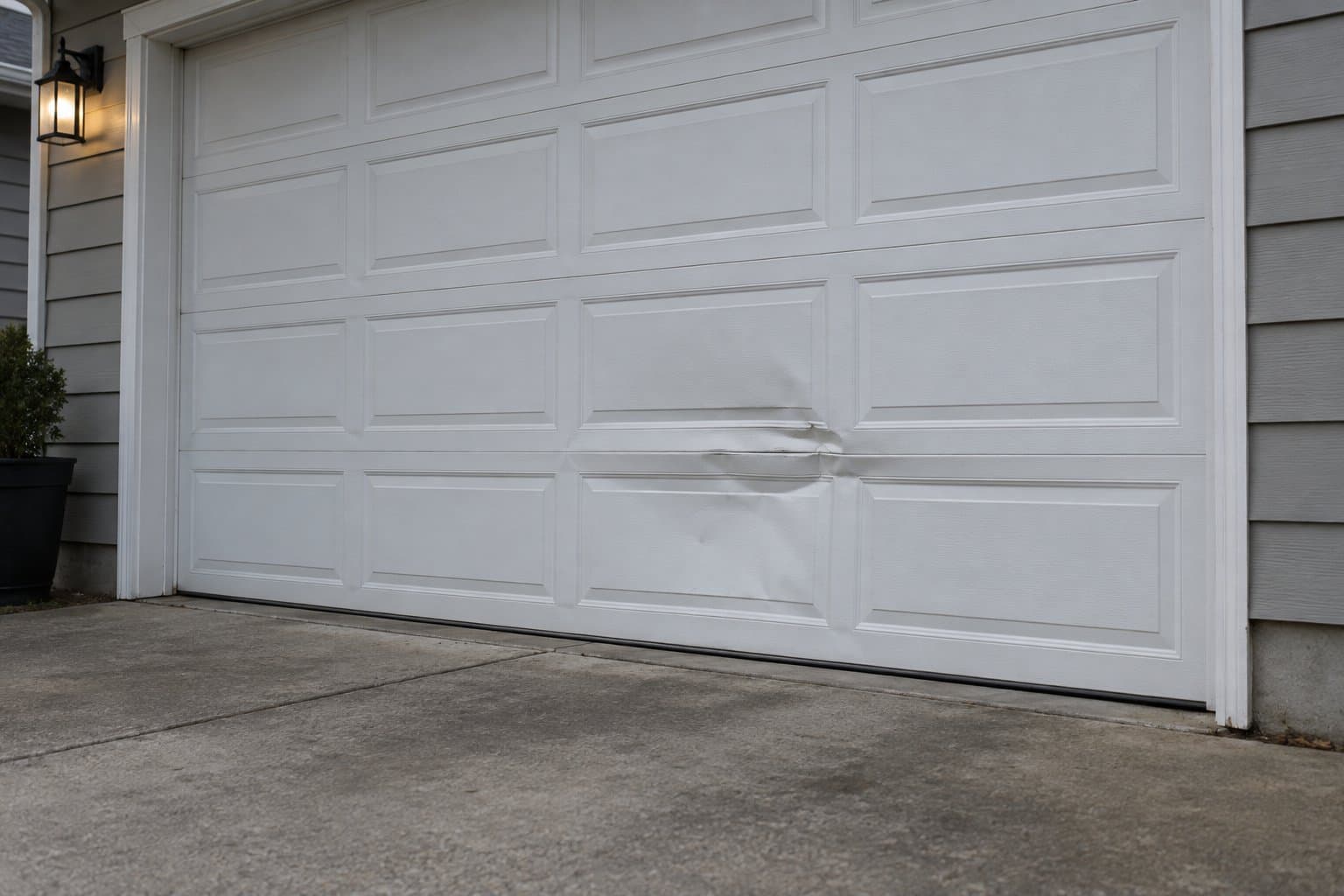
The nuance is whether the bow is only cosmetic or is stressing the rest of the door. A bowed section can pull the hinges and rollers out of line, so it is worth having a garage door technician look at it before it spreads.
Why a panel bows
Garage door sections are thin. Their strength comes from their shape, and sometimes from a horizontal strut fastened across the back. A hit you barely noticed can crease the panel. Once it creases, the metal flexes at that spot and the section slowly sags or bows outward.
Other causes are less obvious. A wide door without enough struts can flex under its own weight. The top section can bow where the opener pulls on it if that spot was never reinforced. Wood and composite panels can swell with moisture. Heat can distort some panel materials. Hail and storm debris are a cause in some regions, and vehicle impact happens everywhere.
A bowed section often shows up when the damage is not limited to one panel. Hinges, rollers and the track beside it may have taken the same hit. A creased panel weakens the whole door even while it still runs, which is why a door that still opens can be a door that is getting worse.
What you can check yourself
- Look along the sectionStand to one side with the door closed and sight along the panel, inside and out. Look for a crease, a crack or a dent where the bow starts, and compare it with the sections above and below.
- Check for a missing strutFrom inside, look for a metal bar running across the back of the section. Note whether it is present, loose or bent. Just look; do not pull on it.
- Look at the hinges and rollers nearbyCheck for hinges that look bent or pulled away from the panel, or a roller sitting out of the track. If the door looks out of line, stop using it and do not try to push it back.
- Take photos and note the detailsPhotograph the whole door and the damaged section, and note the panel colour and style. If you know when the door was installed, write that down too. It helps the technician check whether a matching section is still made.
When to call a technician
Call if the bow came with a crease or crack, if the door runs rough or leans, or if hinges and rollers look damaged. Do not attempt the repair yourself. Springs and cables on that door are under tension, and the work on them belongs to a pro. If the door has come off its track or a cable or spring looks wrong, stop using it. You can reach us at (866) 394-4210, and we arrange a visit with an independent local garage door technician. The estimate is free.
Whether garage door work requires a state contractor license varies by state, and many states leave it to the city or county. The technician holds whatever license their state requires. You can verify that with your state's contractor licensing board. A panel repair almost never needs a building permit. A full door replacement can in some cities and in most coastal high-wind zones, where the new door must carry a wind rating. Ask your local building department before ordering a whole new door.
What the technician will do
- Inspect the whole doorThe technician checks the damaged section and the sections around it. The aim is to find out whether the damage stops at one panel or runs further.
- Check whether the panel is availableOlder or discontinued doors often cannot be matched. The technician tells you if a matching section can be sourced.
- Replace a single section where the rest is soundIf the other sections are in good shape and a match exists, one section can be replaced without replacing the door.
- Add struts where a section has bowedWhere flex is the problem, struts can restore stiffness to the section.
- Check rollers and hinges for knock-on damageThe technician looks over the track rollers and hinges beside the damaged section. They give you the price in person, and you approve it before any work starts.
Related questions
- Can one bowed section be replaced without replacing the whole door?
- Often yes, if the rest of the door is sound and a matching section is still available. On older or discontinued doors, a match may not exist. The technician checks availability when they look at the door.
- Is it safe to keep using the door with a bowed section?
- If the door still runs smoothly and sits in its track, it may work for a short time. A creased panel weakens the whole door, though, and the damage can spread to hinges and rollers. Stop using it if it binds, leans or looks off its track.
- How much will it cost to fix a bowed panel?
- It depends on the door's size and weight, how many sections are affected, whether the panel is still made, how easy the door is to reach, and what the technician finds on inspection. The estimate is free. The technician gives you the price in person before any work starts.
- Will replacing a panel need a permit?
- A repair of this kind almost never does. A full door replacement can need one in some cities and in most coastal high-wind zones. Your local building department decides, so ask them before ordering a new door.
Get a technician out
Free estimate. The price is agreed before the work starts.
Or send us a message
Leave your details and what the door is doing, and someone from the team will call you back.
One Call Garage Door arranges the visit; the technician does the work and gives you the price.