
What does it mean when the opener light blinks and the door won't close?
A blinking opener light paired with a door that refuses to close is the opener telling you its safety sensors are not seeing each other. The two small eyes near the floor on each side of the opening have to hold a clear beam between them before the opener will run the door down, and when that beam is broken, blocked or knocked out of line, the opener blocks the close and flashes the light as a warning.
Phones answered around the clock · free estimate
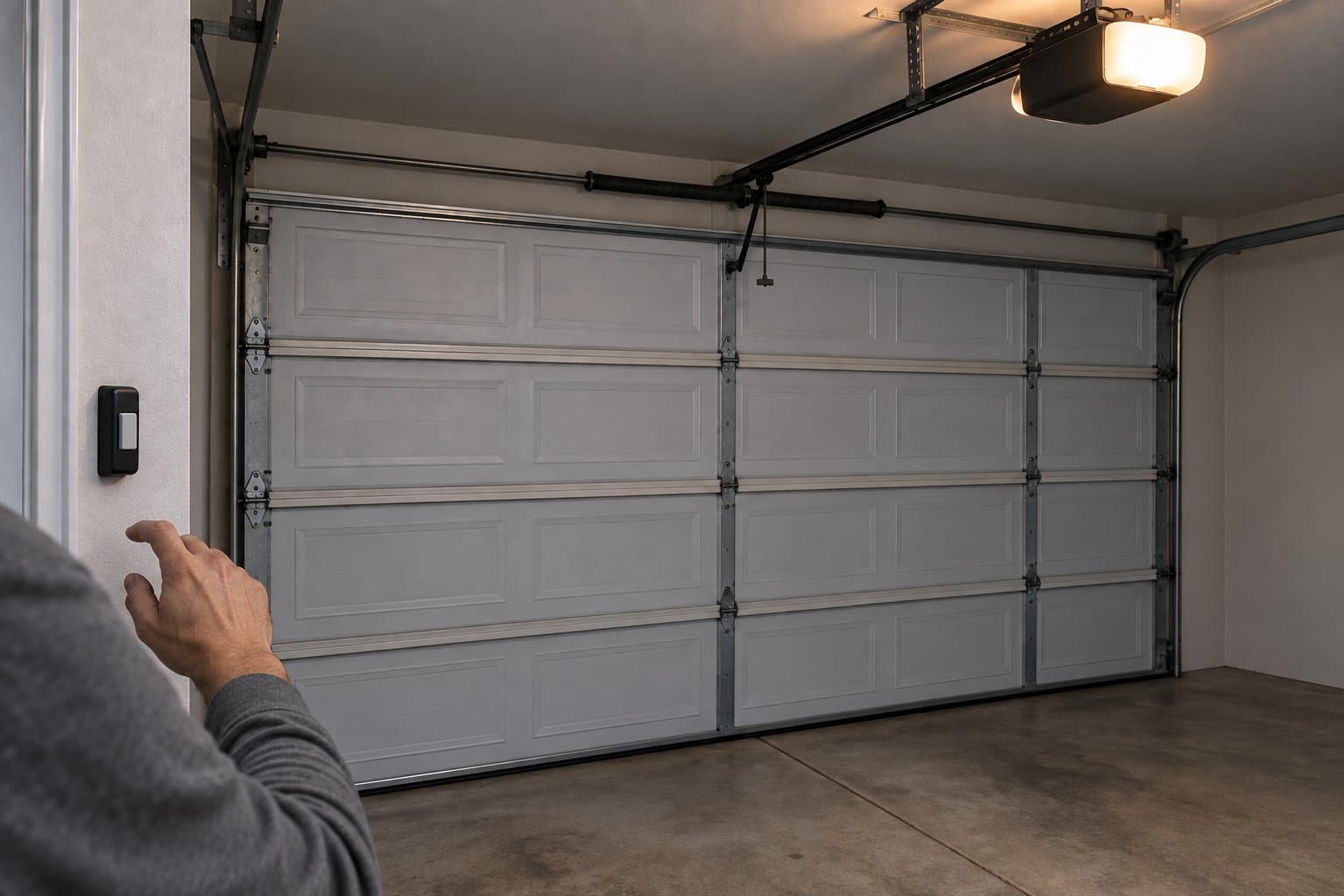
The nuance: not every blink means sensors. Most openers use a blink count as a fault code, and a different count can mean the wall-button lock feature is switched on, the travel limits are off, or the logic board has registered another fault. If the door also opens unevenly, drags, or sounds wrong on the way up, the blink may be a symptom of a door problem rather than an electrical one.
Why it happens
The safety sensors sit a few inches off the floor, which is exactly where they get bumped by a bike, a trash can, a broom handle or a car door. It takes very little movement to break the alignment. Dust, cobwebs and damp on the lens do the same thing without anything being moved at all, and a sensor sitting in direct low sun can be washed out by glare.
Wiring is the other common cause. The sensor wires run along the wall and up the track, and a staple, a rodent or a snagged ladder can nick them. A power cut or a surge can also scramble an opener's settings or un-pair remotes, so a fault that starts right after a storm often has an electrical root.
Then there is the mechanical side. If a spring is weak or broken, a cable has slipped, or the door is binding in the track, the opener may stop mid-travel and flash. Running a crooked or heavy door over and over makes the damage worse, so if the door is clearly struggling rather than simply refusing, stop using it.
What you can check yourself
- Look at the sensor lightsEach sensor has a small LED. On most openers both should be lit and steady; one dark or flickering points straight at alignment, a blocked beam, or a wiring problem.
- Clear and wipe the beam pathMove anything sitting near the floor on either side of the opening and wipe both lenses with a soft dry cloth. A spider web across a lens is enough to stop the door.
- Check for a nudged bracketSight along the floor from one sensor to the other. If one is visibly tipped or turned away from its partner, that alone explains the blink.
- Check the wall button lockMany wall consoles have a lock or vacation button that disables remote closing, and some openers flash to show it is on. Press it once and try the door again.
- Look at the springs and cables from a distanceA visible gap in a spring above the door, or a cable hanging slack beside the track, means the problem is not electrical. Stop using the door and leave it alone.
When to call a technician
Call if the sensors look clean and aligned but the blink continues, if a sensor light stays dark, if the door moves a few inches and reverses, or if it sits crooked in the opening. Those point to damaged wiring, a failing logic board, travel limits out of adjustment, or a spring and cable problem that the opener is reacting to. Never tape, twist or bypass the sensors to force the door down; they are what stops the door closing on a child or a pet.
Whether garage door work needs a state contractor license varies by state, and many states leave it to the city or county. The technician holds whatever license their state requires, and your state's contractor licensing board is the place to verify it. One Call Garage Door arranges the visit with an independent local technician in any of the fifty states, the estimate is free, and the price is confirmed with you before any work starts. Call (866) 394-4210.
What the technician will do
- Read the faultThe technician checks the blink pattern against the opener's own code list and tests the sensor circuit, so the cause is identified before anything is quoted.
- Realign and test the sensorsBrackets are reset, lenses cleaned, wiring traced for nicks or loose connections, and the door is cycled to confirm the safety reverse works.
- Diagnose the opener driveIf the sensors are sound, the technician checks travel and force limits, the drive gear or belt, and the logic board to see what is actually blocking the close.
- Check the door itselfSprings, cables, rollers and balance get inspected, because an opener often refuses to close a door that is out of balance or binding.
- Give the price firstOnce the cause is known, the technician explains the repair and gives the price in person. Nothing proceeds until you approve it.
Related questions
- Why does my door close with the wall button but not the remote?
- Holding the wall button down overrides the sensors on many openers, which is a diagnostic clue rather than a fix. If that is the only way it closes, the sensor circuit is faulty and should be repaired rather than worked around.
- Can I just disconnect the safety sensors?
- No. They are the feature that stops the door closing on a child or a pet, and most openers will not run normally without them connected. Have the fault repaired instead.
- What affects the cost of fixing this?
- It depends on what is actually at fault — a sensor realignment is a different job from replacing damaged wiring, a logic board, or a spring. Door size and weight, access around the opening, and whether parts for an older opener are still made all play a part. The estimate is free and the technician gives the price before work starts.
- Do I need a permit to repair an opener?
- A repair to an opener, springs, cables or rollers almost never needs a building permit. A full door replacement needs one in some cities, and in most coastal high-wind and hurricane zones the new door must carry a wind rating. Ask your local building department before ordering a door.
- The blinking started right after a power outage. Is that related?
- Often, yes. Cuts and surges can scramble an opener's settings, un-pair remotes, or damage the logic board. Try reprogramming the remote first; if the blink stays, the opener needs to be looked at.
Get a technician out
Free estimate. The price is agreed before the work starts.
Keep reading
Or send us a message
Leave your details and what the door is doing, and someone from the team will call you back.
One Call Garage Door arranges the visit; the technician does the work and gives you the price.