
Why does my garage door sag in the middle when it is closed?
A garage door that sags in the middle when closed has almost always lost its stiffness: a section has bowed, a reinforcement strut is missing or has pulled loose, or hinges have worn and let the panels flex. The second common cause is the opening itself — a concrete floor that has settled or heaved, or a door hung slightly out of level, which shows up as a light gap at the center of the bottom edge.
Phones answered around the clock · free estimate
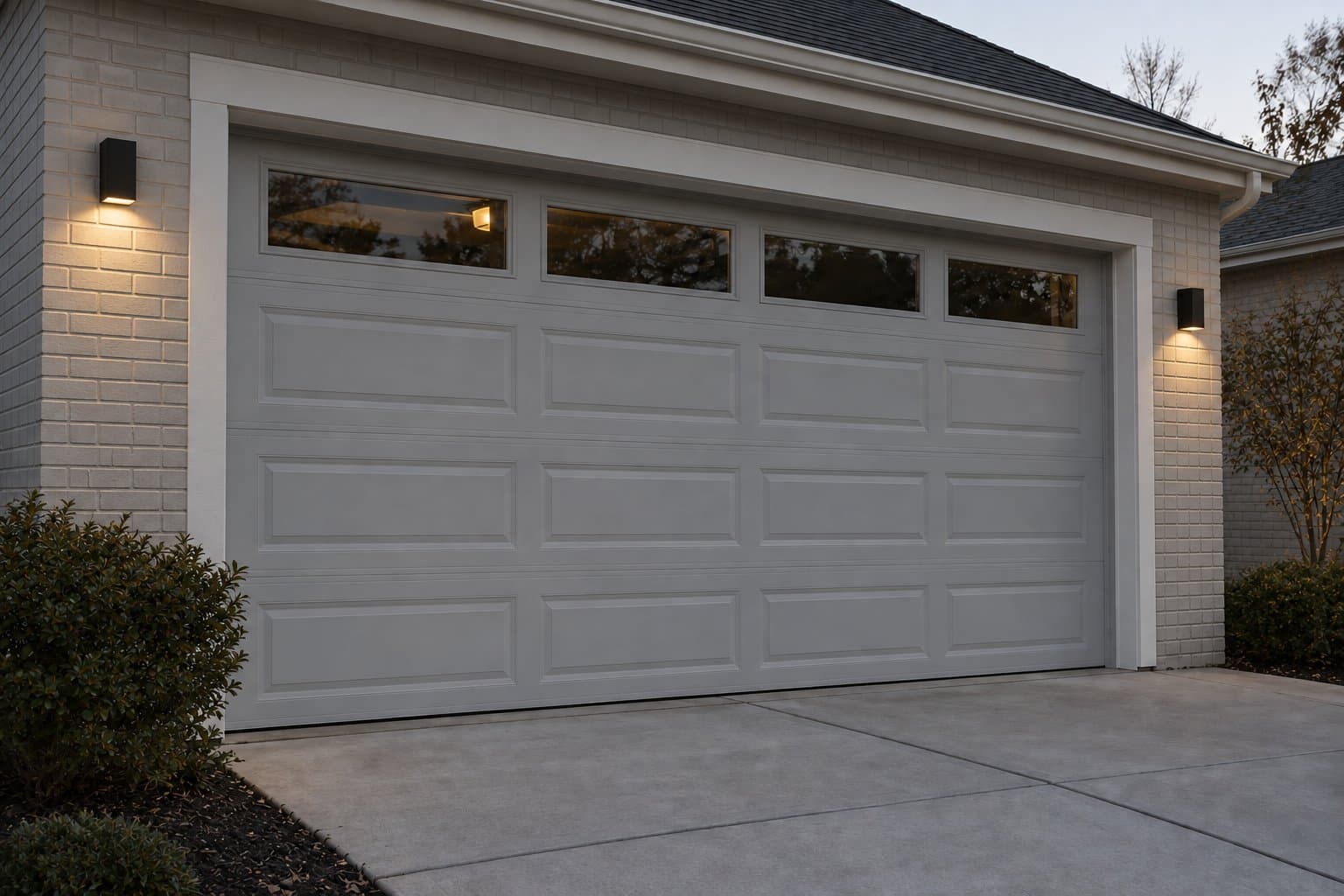
The nuance that changes the answer is where the sag is. Bowing in the top section usually comes from opener pull with no strut behind it. A gap under the middle of the bottom section with the panel itself still straight usually points at the floor or the way the door was hung, not the door.
Why it happens
Garage door sections are light by design. They get their rigidity from steel stiles, end caps, hinges, and horizontal struts bolted across the face. The opener arm pulls on the top section at one point in the middle, so that section takes the most stress. If the strut was never installed, or the bolts worked loose, the panel slowly bends and eventually keeps the shape.
Age and water do the rest. Wood doors soak up moisture at the bottom edge and warp. Steel doors with foam cores can delaminate after a dent or a long run of heat, and the skin stops working with the core. Hinges wear out too — elongated hinge holes let every section rock a little, and the whole door looks tired and uneven when it sits closed.
Then there is the opening. Concrete slabs settle, and a door that sealed flat ten years ago can show daylight in the middle today. A header that has deflected, or tracks set a little off plumb, produce the same look. In those cases the door is fine and the building moved, so straightening the panel fixes nothing.
What you can check yourself
- Sight along the door faceStand at one edge of the closed door and look across it like a straightedge. A bow in one section will stand out immediately against the flat line of the others.
- Look for a light gap from insideWith the door closed and the garage light off, see where daylight shows along the bottom. A thin crescent in the middle usually means the floor or the hang, not the panel.
- Check for a strut on the top sectionFrom inside, see whether a horizontal steel bar runs across the top section where the opener arm attaches. If it is missing, or the bolts are loose, that explains a top-section bow.
- Inspect the hingesLook at the hinges between sections for cracks, rust, or screw holes that have gone oval. Worn hinges let the sections sag against each other.
- Feel for soft or swollen spotsOn a wood door, press the bottom edge and the lower rails. Soft, spongy, or split wood means rot, and the section will keep moving no matter what is bolted to it.
When to call a technician
Call when the sag is visible from across the driveway, when a section is cracked or rotted, when the door binds or scrapes in the tracks, or when you can see a gap in a spring coil or a cable hanging loose. Those last two mean the door is unsafe — stop using it, leave it closed, and do not try the repair yourself. Springs and cables hold the full weight of the door under tension and are not a homeowner job.
If the panels are bowed enough that the door no longer seals or rides straight, replacement is often the better call than patching. A full door replacement needs a permit in some cities, and in most coastal high-wind and hurricane zones the new door has to carry a wind rating — the local building department decides, so ask before ordering. Whether installation requires a state contractor license varies by state, and many states leave it to the city or county; the technician holds whatever license their state requires, and your state's contractor licensing board is the place to verify. One Call Garage Door arranges the visit with an independent local technician, and the estimate is free. Call (866) 394-4210.
What the technician will do
- Find out whether it is the door or the openingThe technician checks the sections against a straightedge and the tracks against level and plumb. That decides whether a repair will hold.
- Measure the opening on siteIf replacement makes sense, headroom, backroom, and sideroom are measured in person, because those dimensions decide which doors and which spring system will fit.
- Talk through styles and insulation honestlySteel insulated, carriage-house, and flush styles are all options. Insulation matters where the garage is attached or has rooms above it, and far less on a detached garage nobody uses.
- Size new springs to the new doorSprings are matched to the weight of the door being installed, not carried over from the old one. A mismatched spring makes a new door sag and wear early.
- Remove the old door and confirm the price firstThe old door and hardware are hauled away as part of the job. The price is given before any work starts, and you approve it first.
Related questions
- Can one sagging section be replaced instead of the whole door?
- Sometimes, if the door model is still made and the rest of the sections are sound. On older doors the exact section is often discontinued, and a mismatched panel rarely lines up or seals properly. The technician will tell you which situation you are in.
- Will adding a strut straighten a bowed section?
- A strut stops further bowing and can pull a mild bow back toward flat. A section that has held its bend for years usually keeps some of it. It is still worth doing, because it protects the sections that are still straight.
- Does sagging mean my springs are bad?
- Not usually, but weak or mismatched springs make it worse by letting the door drop hard onto the floor every time it closes. If the door feels heavy, slams shut, or you can see a gap in a spring coil, stop using it and have it looked at.
- What does a new garage door cost?
- It depends on door size and weight, the style and insulation you choose, whether a wind rating is required where you live, the condition of the opening, and what the technician finds once the old door comes off. There is no price we can quote over the phone. The estimate is free and the technician gives the price in person before any work starts.
Get a technician out
Free estimate. The price is agreed before the work starts.
Or send us a message
Leave your details and what the door is doing, and someone from the team will call you back.
One Call Garage Door arranges the visit; the technician does the work and gives you the price.