
Why is my garage door shaking after I backed into the bottom panel?
The shaking is almost always the bent panel itself: a garage door section is a stiff beam, and once it is creased it flexes instead of holding straight, so the door wobbles as the rollers drag it up and down. Impact also tends to knock the hinges, roller stems and the bottom bracket area out of alignment, which adds binding and side-to-side movement on top of the flex.
Phones answered around the clock · free estimate
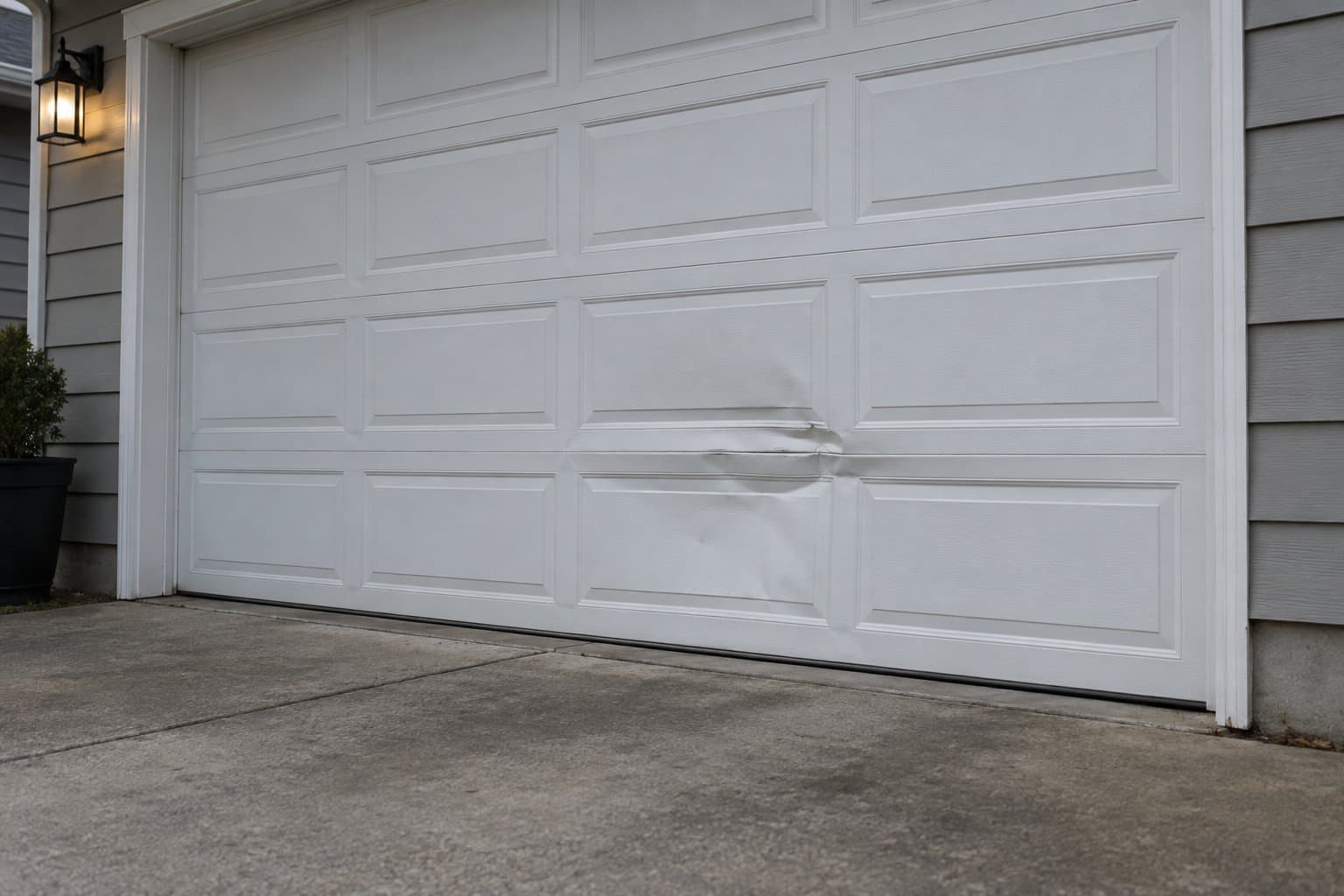
The nuance is that a door can keep running for weeks in this state and still be weakened. A creased panel carries less load than it did, and the extra flexing works on every hinge and roller on that side. If the door now scrapes, hangs crooked, or you can see a cable hanging slack or a gap in a spring, stop using the door and leave it alone until a garage door technician has looked at it.
Why it happens
Each section of a sectional door is designed to stay rigid across its full width. A vehicle bumper concentrates force in one small spot, and the steel or composite skin folds. Once folded, that section bows under its own weight and under the pull of the springs, and the bow is what you feel as shaking.
The bottom section takes the extra job of carrying the lift cables and the bottom brackets. Impact there can twist the bracket mounting area, push a roller stem out of square, or bend the track the roller runs in. A roller that no longer sits straight in the track chatters, and that chatter travels through the whole door.
Hinges are the other common casualty. A hinge that gets bent or whose screw holes have pulled out lets two sections move independently, which shows up as a rattle at the seam. Vehicle impact is the usual cause everywhere, though hail and storm debris do the same thing to panels in some regions.
What you can check yourself
- Look at the crease from insideWith the door closed, look at the back of the damaged section. A sharp fold or a split in the skin means the section has lost strength, not just paint.
- Watch the gap at the seamsStand back and watch the door run. If the seam between the bottom two sections opens and closes as it moves, a hinge or the panel itself is flexing.
- Check the cables by eye onlyLook at the cable on each side running from the bottom of the door up to the drum. If one is slack, frayed or off its drum, stop using the door and do not touch the cable.
- Listen for a new soundA chatter or knock that starts at one point in the travel usually means a roller or a bent spot in the track. Note where in the travel it happens so you can tell the technician.
- Check the track for a bendLook along the vertical track on the damaged side for a dent or a spot where the track is pushed away from the wall. Do not try to bend it back.
When to call a technician
Call once the door is shaking, running crooked, scraping the frame, or if anything about the cables, springs or track looks wrong. Those systems are under high tension and are not homeowner repairs. Do not force a door that binds, and do not keep cycling it to see if it settles.
Most panel and hardware repairs do not need a building permit. A full door replacement does in some cities, and in coastal high-wind and hurricane areas the new door usually has to carry a wind rating, so ask your local building department before ordering one. Licensing rules differ by state and sometimes by city; the technician holds whatever license their state requires, and your state's contractor licensing board is the place to verify it. One Call Garage Door arranges the visit with an independent local technician, and the estimate is free — call (866) 394-4210.
What the technician will do
- Check whether the panel can still be matchedThe technician identifies the door and looks for a matching section. Older doors are often discontinued, and that changes the options.
- Replace the single section if the rest is soundWhere the other sections are straight and the hardware is good, swapping just the damaged one is usually the route taken.
- Add a strut where a section has bowedA horizontal strut stiffens a section that has started to flex. It is often used alongside a panel swap on wide doors.
- Inspect hinges, rollers and trackImpact damage spreads. The technician checks the hinges, roller stems and the track on the struck side for knock-on damage and straightens or replaces what is bent.
- Give you the price before anything startsThe estimate is free. You see the price and approve it before any work begins.
Related questions
- Can I keep using the door until the panel is fixed?
- If the door runs smoothly, sits square and the cables and springs look untouched, light use is usually fine for a short time. If it shakes hard, scrapes, hangs crooked or a cable is loose, stop using it. Every cycle works on hardware the impact already stressed.
- What if my door model is discontinued?
- It happens often with older doors, and it is the first thing the technician checks. When no matching section exists, the choices are a close-but-not-identical panel or replacing the whole door. The technician will lay out both before you decide.
- Does one bent section mean I need a whole new door?
- Not necessarily. If the other sections are straight, the track is true and the hardware is sound, a single section replacement is normally enough. A whole-door recommendation usually comes from a discontinued panel, several damaged sections, or a frame that took the hit.
- Why does the opener strain now that the panel is bent?
- A flexing section and a binding roller make the door harder to pull, so the opener works against more resistance. Fixing the panel and hardware normally takes that load back off. An opener that has been straining for a while should be checked too.
- Does a panel replacement need a permit?
- A repair like a single section, struts, hinges or rollers almost never does. A full door replacement needs one in some cities, and in most coastal high-wind and hurricane zones the new door must carry a wind rating. Ask your local building department before ordering.
Get a technician out
Free estimate. The price is agreed before the work starts.
Or send us a message
Leave your details and what the door is doing, and someone from the team will call you back.
One Call Garage Door arranges the visit; the technician does the work and gives you the price.